Thursday, July 5, 2018

2018 American Artisan Festival


The storm roared outside. Wind gusts flapped the side walls and rattled the roof rafters. Our tent was being pelted by nickel-sized hail and flooded by two inches of cloud-burst rain. We had not been able to close the tent’s roof vents, nor were we able to zip up the side walls, so rain was now spraying onto the artwork inside. Scrambling to protect the watercolor paintings hanging from the display panels, Betsy and I worked frantically to unfurl a large piece of clear plastic and to hopefully cover everything of value inside the tent. It wasn’t until later that we recalled we were laughing the entire time.  

It was Day 1. 

The 2018 American Artisan Festival was a ton of fun, despite some challenging weather conditions. Despite the heat, humidity and occasional hailstorm, the crowds were steady, and very thankfully, many of those who attended stopped by my tent to view my displayed artwork. 

As always, I enjoyed the heck out of meeting with people, including many of my fellow vendors. While I’d hardly call myself an art show veteran, I’ve done enough of these festivals to know a sense of community quickly emerges as the tents are erected and displays are completed. Everyone helps one another, offers support and certainly shares ideas. Each artist wants to have a successful show, but we're always rooting for the other artists, too. 

Survived Storm No. 1
Over the three day festival, I had plenty of chances to meet new admirers of my work, and even sold a few paintings/prints along the way. Even though I’ve been at this for a while, there’s a wave of emotions that come with each sale. It’s equal parts flattery, elation, honor and maybe a little embarrassment. I sell my work because people have thankfully expressed interest in my art, and I’m always glad to see someone else happy … especially if I can “make” them happy through one of my creations. The honor comes from the understanding that someone has connected so much with a painting that they want to take it and hang it — and hopefully admire it — in their home. That’s actually a gift to me that keeps on giving. The embarrassing part comes from the transaction itself. Even though I’m now used to taking payment for my work, there’s a counterbalance of mild incredulity. That might be too strong a word, but maybe it keeps me grounded. After all, you can never ever take for granted that someone will like a painting enough to buy it. 

The prevailing subject matter of my work always reels in more than few fellow fishermen and fisherwomen. It was the same deal at the American Artisan Festival, and I had plenty of opportunities to trade fish stories or to talk about some of the species presented in my paintings with a wide variety of interested anglers.  

Throughout the show, the weather kept throwing haymakers, as the heat indices rocketed each morning, and the afternoons bursted forth some truly impressive storms. Even when strafed with hail, all of the artists rallied and endured the mad scramble to protect wares and to hold on from being blown away. 

Somewheeerrre, over them rainbows ...
After each deluge, when we peeked out from our tents and soggily emerged into the gathering heat, we’d smile or nod at nearby vendors, unzip the tent walls and get back to business. And, each time, welcoming us back was a rainbow in the east and at least the temporary promise of clearing weather. 

Thanks to everyone who attended and stopped by my booth, thanks to Samantha and the American Artisan Festival volunteers for putting on a good show, and special thanks to Betsy, who stuck with me through the entirety of the festival. There are a lot of definitions for true love, but there should be special consideration for spending four incredibly hot days in a tent with a sweaty husband. Love ya, Bets. 

Friday, February 12, 2016

Skunked: Fly-fishing for Muskie


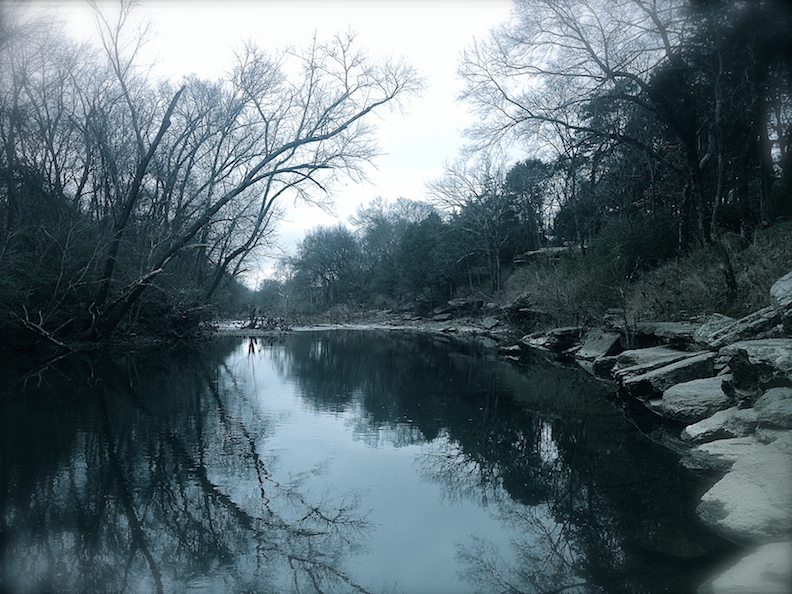
A pale and milky-green rivulet of ice water flowed past the minarets of the single-lane bridge, and downstream through the corridor of oak and sycamore and osage orange. Their leafless limbs scratched and clawed at the frigid air. No birds. No turtles. No squirrels. Just wind, which blew cold and miserable in our faces as we pushed upstream in the Hyde drift boat, the newly-installed trolling motor murmuring from the stern. I stood forward, my hips pushed against the casting brace and scanned the silky water, looking for muskie. 

Dangling from the business end of a burly 10-weight fly rod in my right hand, a comically-huge bundle of fur, flash and feather, in oranges and pinks and black with iridescent strands of greens and silver and red. A deranged disco chicken. The “fly” was ridiculously large, with a matching hook that could double as a hand-gaff. When I first saw it, my right elbow recoiled in horror. You want me to cast this?

After a half-hour push to the desired spot, the trolling motor ceased and the current began to gently push us downstream. I stripped line into the tray in front of me and jerked the rod tip backwards, beginning my first cast. The chicken snapped to life and whooshed through the air towards the trees behind me. I tugged the fly-line with my left hand and the fly gathered speed as I powered through the forward cast. Instead of unfurling in a gentle loop, the gaudy offering ignored the imparted momentum and flopped and fell as it had been shot from the sky. It splashed down in the water with an awkward “bloop.” 

Strip, pause, strip, pause, strip, strip, strip, pause. Double haul. Strip, pause, strip, pause, strip, strip, strip, pause. Double haul. Repeat. Over and over. The countdown to 10,000 casts began. 

Everything looked fishy. Rocks. Boulders. Downed trees. Drop offs. Ledges. Gravel bars. Mud banks. The river was small, more of a stream and bigger than a creek, but charismatic. Stone-gray limestone bluffs appeared in each bend, and after each shoal, the river plunged into a deep, dark-blue hole. The fish could be anywhere. So we casted everywhere. Cast after cast, the fly plunked near the river bank before becoming alive with the retrieve, as it pulsed, darted, flashed and danced through the milky water. 

The first hour was sopped with anticipation. With each presentation, I believed a 50-inch muskie would explode from its hidden lair, jaws agape and eyes bulging, gills flaring and teeth flashing. It would not just take the fly … it would assassinate it. I would coolly execute a perfect strip-set, keeping my rod-tip low and driving the massive hook into the bony maw of the fish, and sending the big pike into a thrashing, splashing, fit of fury. Hell yeah, that's what I'd do.

However, over the next hour, high hopes predictably diminished, as no river monsters emerged to sharpen our senses. The casts became routine. Concentration fractured into the tiniest flecks and floated away in the unremitting hiss of the northerly breeze. While my casts and retrieves were precise, my intensity and focus were not, and I slipped into a robotic, almost hypnotic, state. The fly continued to dance and dart, but so did my mind. Rounding the 1000th cast, Jeff Goldblum’s line from Jurassic Park began repeating in my head … “Ah, now eventually you do plan to have dinosaurs on your, on your dinosaur tour, right?”

I was warned that my elbow would ache. The forecast was accurate. Casting the gigantic bundle of fur, flash and feather required way more effort than I intended. The fly was like a wet tube sock, and propelling it to and fro caused considerable strain on my shoulder, elbow and wrist. My right hand was clenched in a permanent claw, and I worried I'd need help prying it loose from the rod cork when it was my turn to row. 


The day slowly trudged by, and we continued to place our flies into productive water but failed to garner any results. I noticed there were no other boats on the river. Ordinarily, I’d love that. Today, though, the loneliness piled upon my growing doubts. The stories we shared on the way to the river, of past trips and great catches and near misses and “oh my God, you shoulda seen it” tales seemed so distant. 

And some things that should not have been forgotten were lost. History became legend. Legend became myth. And for two and half thousand casts, the muskellunge passed out of all knowledge.* 

On or about the 10,000th cast, the fly splashed into the water about six inches from the mud bank. I twirled line in my left hand and removed slack. The disco chicken came alive with the first strip, and pulsed and darted over the top of a partially submerged tree. A big flash, then, the fly disappeared. 

It took a critical, half-second for me to realize what happened. And, in that minute fraction of time, I forgot everything I had been instructed to do when a muskie attacked. Instead of “Strip set … keep the rod tip low ... don't panic," I opted for "trout set .. rod tip high ... freakout." My reaction was crap. Really crap. Compounding things, I inexplicably dropped the line from my left hand, giving the fish plenty of slack. Which was bad. Really bad. 

By the time I regained composure — which was all of a two count — the fish had spit the chicken, and swirled back to its initial position behind the tangle of limbs. I gave it a few more casts, hoping to annoy it into biting again, but it gave me the middle fin, and wouldn’t budge. 

And, that was it. 

I sat down to row for awhile, while my buddies plied the water for fish. Opposing fly lines whizzed about my head as water-soaked flies whistled and whirred, and the sun fell behind the surrounding bluffs, the gray day dimming further.

No fish were landed. Hell, none were even hooked. But, we had “raised” four, which I'm told is a pretty decent day for muskie fishermen. Particularly, for fly-fishing muskie fishermen. In the cast iron twilight, we loaded the drifter back on to the trailer, stowed our rods and gear, and swung our frozen feet into the welcomed heat of the truck. 

The muskellunge has been referred to as the “undisputed king of freshwater predators,” which, I think is baloney, because it’s either one of those blue catfish the size of cars that live below dams and scare divers, or David Perry. But, a muskie is an apex predator; it’s big, it doesn't suffer fools, it eats ducklings and very, very, very occasionally, huge, comically-colored flies. 

And someday … I’m gonna catch me one.


*Sort of borrowed/stolen/vandalized from Tolkien.